WHAT’S YOUR PARTNERSHIP RECIPE? LESSONS FROM A CUPCAKE-THEMED WONDERING SESSION
At Washington University’s Institute for School Partnership (ISP), the concept of partnership defines our work as researchers and practitioners interested in advancing high-quality, equitable education and is central to all we do. We are privileged to partner with hundreds of schools and thousands of educators each year across many different programs, projects, and initiatives ranging from fee-for-service professional learning and curriculum programs to long-term research-practice partnership (RPP) work. Just as teacher collaboration is a vital tool in producing healthy learning communities and positive outcomes for students, research has also shown that collaboration between and across teachers, administrators, professional learning providers, and researchers yields more actionable and effective knowledge needed to develop sustainable and implementable change (see for example here, here, and here).
Across decades of work and myriad partnerships, we have learned that while there are wrong ways to form and work in partnership, there is no one right way to “do” partnership. With that in mind, how do we know which components are central to forming and being a healthy partnership? Here, we share insights from a collaborative wondering session we led last summer during the NNERPP Annual Forum.
OUR PARTNERSHIP APPROACH
We begin with a quick look at our approach to partnership at the Institute for School Partnership. In 2021, we drafted a visual model to describe our approach to successful partnerships with schools as our core methodology to address persistent challenges in education (see below). This model is centered on students and our goals for seeing them thrive, and then visualizes how our partners (schools and districts on one side and ISP on the other) bring different “ingredients” to the partnership, based on their position, ability, and knowledge. Our model demonstrates how bringing these ingredients together through purposeful collaboration enables us to achieve our shared vision for students.
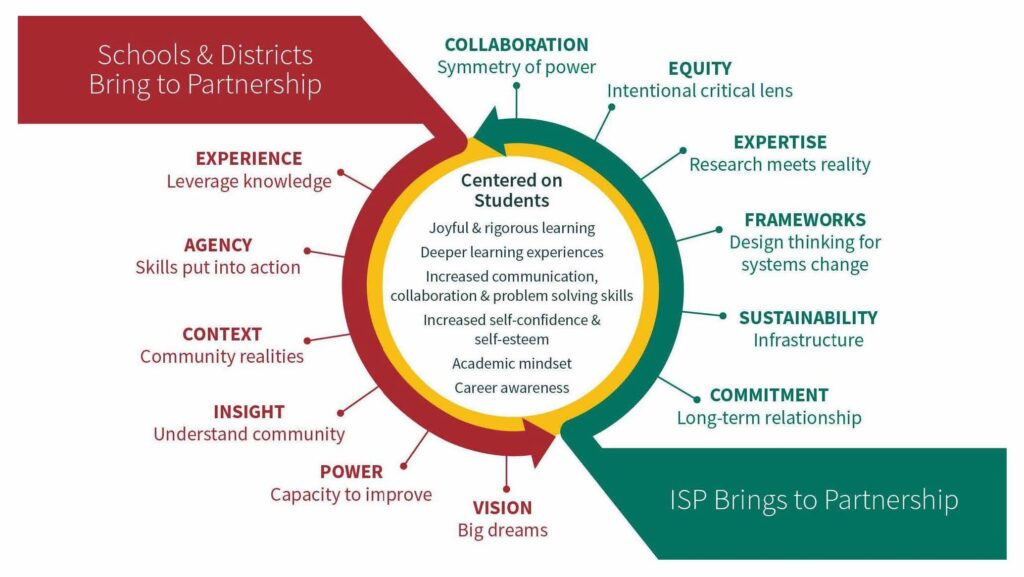
Figure 1. ISP’s approach to partnership is centered on students and shows how together, ISP and schools and districts can achieve our shared vision for students.
These ideas are the foundation from which we approach partnership with schools, allowing for flexibility and fluidity across staff turn-over, shifting funding landscapes, and changes in the material contexts of communities that are inevitable over the years. On this one foundation, we have built many partnerships that look and function very differently. While this demonstrates a unique strength of the partnership approach, namely its flexibility and adaptability to highly localized contexts, it does make it harder to understand which elements are or are not necessary. Enter the NNERPP community and a cupcake-themed learning session!
THE GREAT RPP BAKE OFF
To help those of us working in RPPs get a better idea of what the essential components of healthy partnerships might be, we brought together a group of people engaged in RPP work in various roles at last summer’s 2025 NNERPP Annual Forum. Together, we contemplated the ISP approach to partnership, participants’ own approaches, and the overall question: What are the essential components to build strong, lasting partnerships and how do these ingredients come together to achieve shared goals?
The Cupcake Metaphor
In thinking about partnerships, we found it helpful to imagine our approach to partnership as a bakery serving partnership cupcakes across a broad range of sizes, flavors, and designs, but where customers know that they will get all the main ingredients for a healthy partnership regardless of which cupcake they order. As a group, we described the elements of successful partnerships we had personally worked within using the metaphor of baking and decorating a cupcake and looked at common themes to stretch our thinking.
Baking a great cupcake requires preparation, the mise en place of gathering the ingredients and getting them ready. We considered what needs to be in place at the beginning of a partnership project. We asked participants to consider the processes of selecting, measuring, mixing, and baking the ingredients as the context and constraints in their partnerships. We imagined a cupcake consisting of cake or sponge as the foundation, the gooey center as the heart, the frosting as the piece that brings the flavors together, and the caketopper or showstopper as the ‘wow’ factor that sells the whole thing.
We shared the example of a current, ongoing RPP in early childhood education between the ISP and a local school district focused on increasing kindergarten readiness, as a cupcake we termed The Elvis.
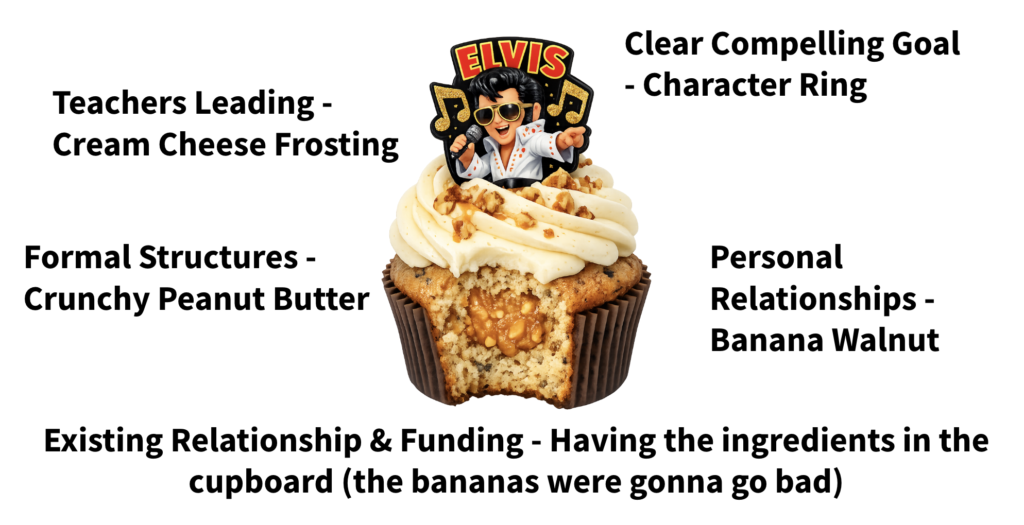
Figure 2. This "partnership cupcake” illustrates ISP’s RPP with a local school district focused on increasing kindergarten readiness, with the main "ingredients” labeled.
Note: Image generated using the prompt: "Create an image of a banana walnut cupcake with crunchy peanut butter center, cream cheese frosting, and a fun elvis themed character ring on top. The image should not have a background and should be in a simple, professional, realistic style," by ChatGPT, OpenAI, DALL-E3, ,2025 (https://chatgpt.com/)
The preparation or mise en place for this partnership was bringing together two existing relationships: a district where we had a long history of providing fee-for-service professional learning and curriculum supports for K-8, and a funder interested in supporting early childhood learning. Just as making a banana cake is a no brainer when the bananas in your cupboard are starting to turn brown, it felt natural to approach this district where they had recently rolled out prekindergarten classrooms across all of their elementary school buildings.
The foundation of the RPP is truly the personal relationship between the district’s director of early childhood education and the ISP’s director of math and school leadership programs. This banana-walnut combination is greater than the sum of its parts. But, just as both bananas and walnuts are common allergens, we acknowledge that basing an ambitious, multi-year, research project on the personal relationship between two people is precarious and not something that works for other partnerships.
Following the allergen theme, this cupcake is filled with the crunchy peanut butter of formal structures including the district’s research planning and approval process in addition to the University’s IRB, monthly RPP team meetings following a standardized agenda, and an annual MOU process with the district that includes cost-sharing for professional development and coaching as part of the study. These formal structures can impede and sometimes sour partnerships built on personal relationships, but without them, the project would have stalled and could not result in the production of new knowledge.
The frosting on our RPP cupcake is that the project is being led by teachers, here represented by cream cheese frosting which, just like teacher leadership, is our favorite.
Our cupcake is topped by the character ring tchotchke of our clear and compelling goal to increase kindergarten readiness, which for a fan could be enough to choose this cupcake even if the flavors weren’t their first choice.
Common Themes Across Partnership Cupcakes
Participants in our session described their partnerships following this analogy, imagining their partnership as cupcakes as well as wedding cakes, a mug cake, and a heart-shaped cake.
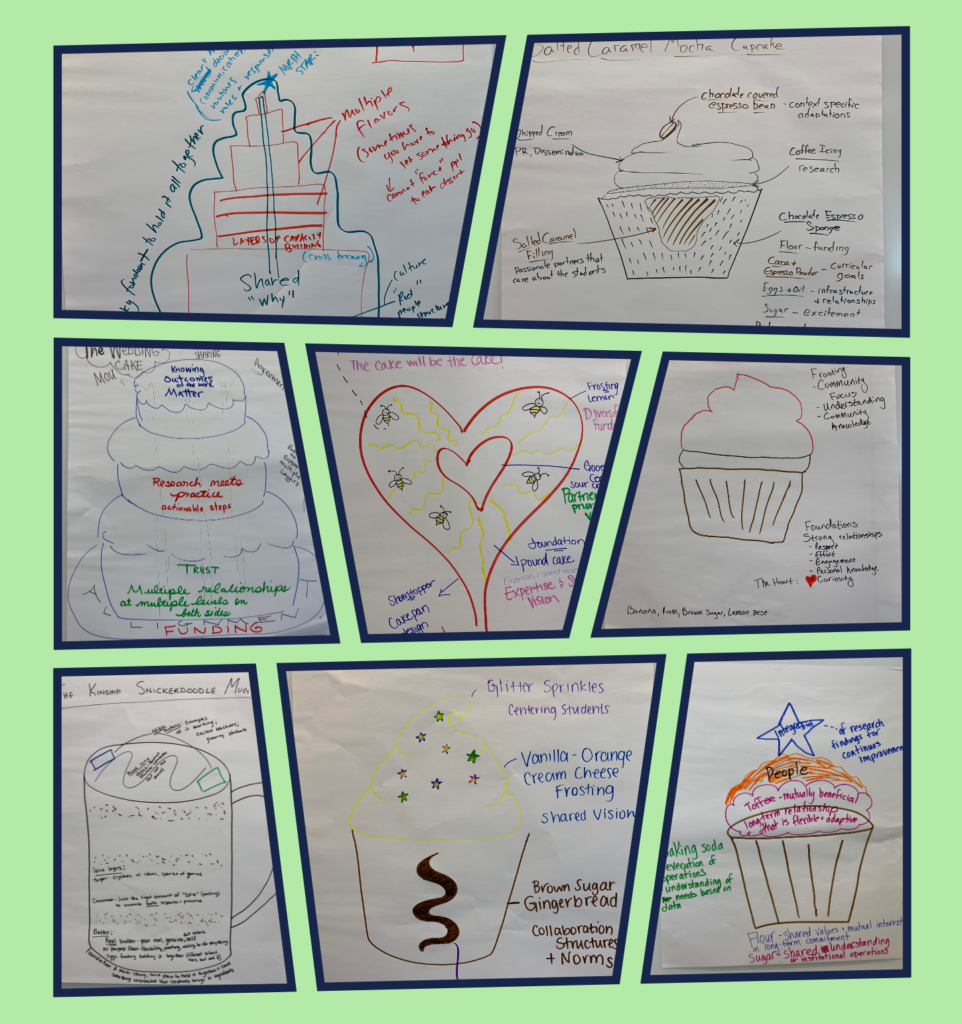
As a group, we conducted a gallery walk looking at common themes and discussed how these different ingredients came together in different ways but shared recognizable characteristics. Our common themes were:
- Trust and vulnerability are the foundation of strong partnerships which require us to come together as professionals who acknowledge that we are all human with full lives and foibles. Through that trust and vulnerability, we are able to lean on each other’s expertise and knowledge.
- Goals must be mutually beneficial and shared. What constitutes success for a researcher is materially different from that of a teacher or school administrator. It behooves us to take the time and make space to identify and reflect upon mutual interests and to invest in a shared vision.
- We need to attend to each other’s priorities and consistently show up with flexibility and active listening on all sides. Our openness is what allows us to capture the sugar crystal sparks of genius and leverage the salted caramel of passion for our work.
- Funding is an important ingredient–it always matters and is not neutral. How and when its influence is most felt is different across successful research-practice partnerships.
- While the work of education RPPs ultimately aims to produce more positive outcomes for students, questions arose around where, how, when, or even if students had a role in those partnerships.
REFLECTION
Going through this process of playing pretend and applying an analogy to our work helped us reflect on our partnerships and supported intentionality in planning so that we could better maximize the benefits of those partnerships.
If you have wondered about which ingredients make for a successful partnership or found yourself struggling with “baking” your RPP or determining the right recipe, this activity could be useful to you and your team! We invite you to reflect on your own partnerships and offer this cupcake bakery analogy as a tool to consider both successful and less successful partnerships:
- Mise en Place: What do you or did you need to prepare ahead of entering into the partnership? What resources are required and what makes things easier to partner?
- Cake/Sponge: What is the foundation that your RPP builds on, that if stripped away could leave you with a weird mess?
- Gooey Center: What is at the heart of the partnership that makes it special?
- Frosting or Flavor Enhancer: What aspects of the partnership elevate and complement the core bringing it all together?
- Cake Topper/Showstopper: What is the “wow factor” of your partnership? Are there big wins, meaningful impacts, or proud moments that would lead you to choose this partnership a second time?
- Mixing Bowl & Measuring Cups: What holds everything together and keeps it from spilling over? What gets added first, how much, and why?
- Oven & Baking Pan: What shapes your partnership? What context, constraints, or opportunities are you working with?
- Serving Suggestions: How do you share and sustain the partnership?
- Lastly, how does your recipe compare to the common themes identified above?
Enjoy!
Maia Elkana is Evaluation Director at the Institute for School Partnership (ISP), Carol Colaninno is Associate Director, Academic Services at ISP, Alexandra Forgerson is Instructional Specialist at ISP, and Rachel Ruggirello is ISP's Associate Director.
Suggested citation: Elkana, M., Colaninno, C., Forgerson, A., & Ruggirello, R. What's Your Partnership Recipe? Lessons From a Cupcake-Themed Wondering Session. NNERPP Extra, 8(2), 12-17.