INTRODUCING A SUSTAINABILITY FRAMEWORK FOR RESEARCH-PRACTICE PARTNERSHIPS
RPP sustainability remains one the most asked about aspects of RPP work within both NNERPP and the broader RPP community, based on conversations we’ve had over the past 10 years. Financial sustainability tends to be the first point of entry into RPP sustainability conversations, with RPP teams often asking how to secure resources to support the work. While money and related financial support certainly matters, our collaborative conversations with NNERPP members and friends suggest that a few other aspects of sustainability are important to consider as well, especially in the face of potential threats related to staff turnover, shifting education landscapes, internal and external conflict, and lacking operational infrastructure.
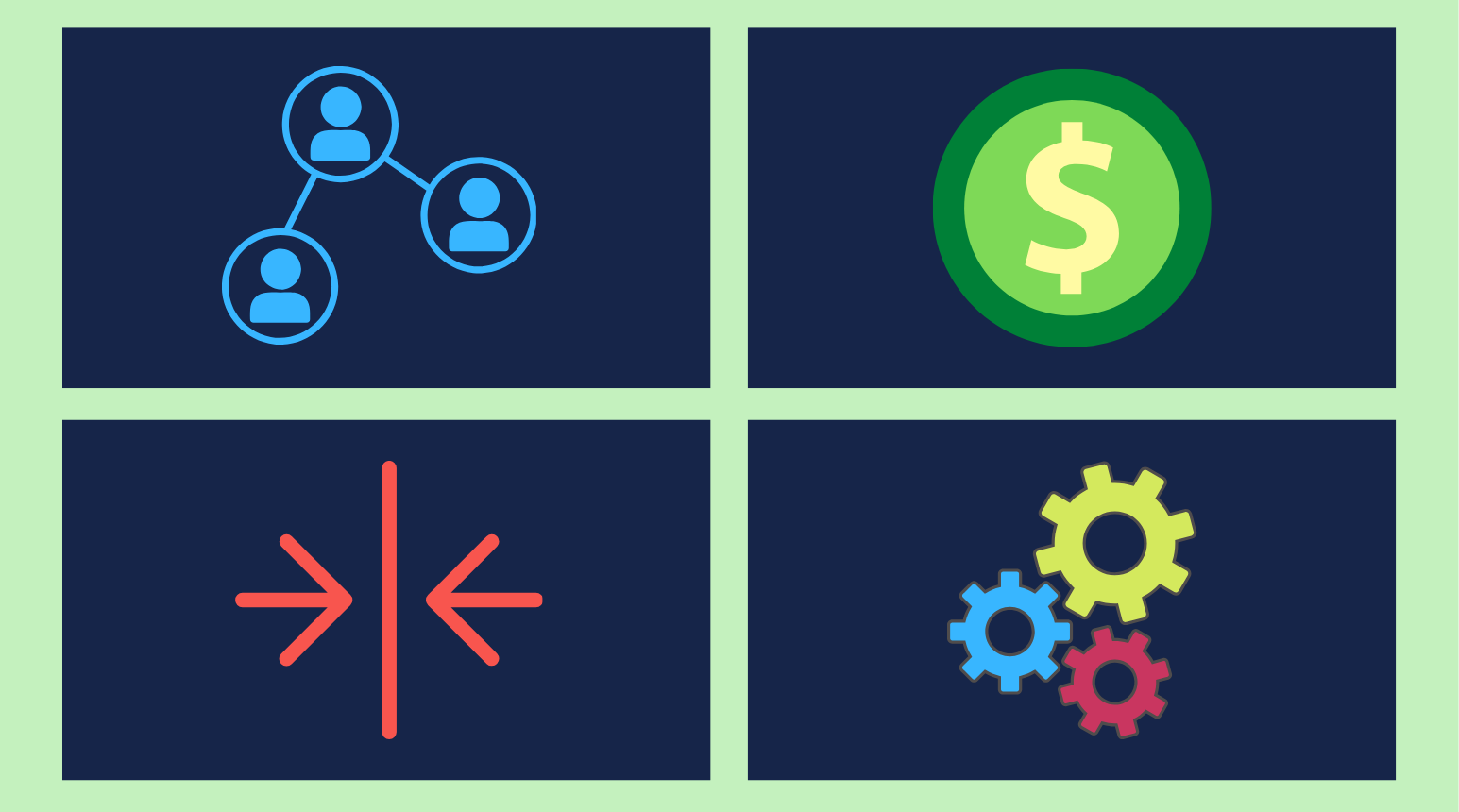
To address RPP sustainability comprehensively, NNERPP has co-developed a sustainability framework with our community that encourages partnerships to reflect on four key dimensions of long-term sustainability: financial sustainability, relational sustainability, goal alignment, and infrastructure. This framework was created with input from a wide group of NNERPP members and friends across several Annual Forums and other spaces and has evolved over time. After several iterations, we are excited to formally introduce the framework via a new resource: “A Sustainability Framework For Research-Practice Partnerships: A conceptual framework developed with members and friends of the NNERPP community articulating key dimensions of long-term sustainability for education RPPs.”
In this article, we share a bit more context to help situate the intended use cases for this tool, including why we developed it, how we adapted the tool over time until it became its current version, and a suggested way teams might engage with it. We hope you will find the sustainability framework to be helpful to you and your RPP team! We invite you to let us know how you’ve used it here.
WHY THE FRAMEWORK
RPPs often wrestle with sustainability due to the nature of the work, which is built on things that can be fragile, including trust and collaborative relationships, requires partners from different organizational backgrounds, cultures, and priorities to work together, and is often reliant on outside funding. Our comprehensive framework seeks to help RPP participants define, assess, and address the four dimensions that our community has identified as key dimensions of sustainability. We share more context around the development of the framework below, and then provide some guidance for how to best use it.
A (very!) brief overview of the four dimensions
We invite you to dive into the framework itself for a much more in-depth description of each dimension!
- “Relational sustainability” refers to the human element of connection and relationship that drives the work of the partnership.
- “Financial sustainability” refers to the resources that directly support the partnership’s efforts.
- “Goal Alignment” refers to the extent to which partnership goals align across the RPP’s participating organizations.
- “Infrastructural sustainability” refers to the partnership routines, processes, and physical infrastructure that help support the work.
DEVELOPING THE FRAMEWORK
Background
We first started putting our thoughts on and knowledge about RPP sustainability into the beginnings of a framework in 2019, prompted by an invitation to Paula to discuss how RPPs can become sustainable through securing funding at a CS4All learning session during a NSF Principal Investigators meeting. At that point, we had already had some initial conversations about RPP sustainability with members and friends of NNERPP. One theme that surfaced across these conversations: Funding isn’t the only thing that matters to sustaining an RPP. Paula took these thoughts to the NSF meeting in the form of a drafty RPP sustainability framework – a 1.0 version with only 3 dimensions: financial, relational, and goal alignment.
After an immensely generative conversation with colleagues at the NSF meeting, we took the framework back to our community for further iterations, making sure it was grounded in actual RPP practice and the experiences of RPPers. We hosted conversations at the 2020, 2021, 2025, and 2026 NNERPP Annual Forums, each time inviting participants to think through the dimensions, reflect on their own practices, and offer feedback on how and whether the dimensions were still valid.
Next, we invited additional feedback from our colleagues who are listed on the front page of the framework –Hayley Weddle, Kim Wright, Steven McGee, and Simon Sjölund– who all did a close read of the framework and provided further refining ideas and questions.
The final (or not!) product we share today should thus be considered a community-wide collaborative effort to document our best thinking on what matters for RPP sustainability. As suggested in the previous sentence, and as you might have already guessed from our descriptions of the iterative nature of drafting the framework, we don’t think this is the “final-final” version. We’ll keep testing it and updating it as we go – and as RPPs continue to change and evolve!
Three big shifts
In the course of our iterations, three big shifts marked the evolution of the framework, mirroring the shifts in our understanding of RPP sustainability:
(1) Starting out with three dimensions…
In our first conceptualization of the framework, we identified relational sustainability, financial sustainability, and goal alignment. In conversations with NNERPP members and friends, these three seemed to capture key aspects of sustainability that teams would need to attend to as they enacted their RPPs. During the 2019 NSF CS4All session, the group engaged in a robust sensemaking discussion, affirming that these three did seem to matter.
(2) … to adding the infrastructure dimension…
It was during the 2020 NNERPP Annual Forum that we added the fourth dimension, infrastructure. During our riffing on the framework, several people noted the importance of both invisible infrastructure, such as routines, processes, and protocols that a partnership frequently relies on to function, and physical infrastructure, such as databases and memoranda of understanding. This dimension thus captures many of the aspects related to “operationalizing” the RPP, which is important to sustaining, since money, people, and a north star are just that without any bones holding them together.
(3) … to changing how the dimensions are structured in relationship to each other
Initial drafts of the framework depicted the four dimensions as four dots in a circle, suggesting some kind of order to or specific connectivity between the dimensions. As we continued reiterating, we realized that how –or if– the four dimensions connect is likely different for each individual RPP and its context and goals. So rather than predefining any relationships between them, we have come to see the sense-making of how the dimensions interact as a valuable exercise for each individual RPP engaging with the framework (which is what you’ll see on the final pages of the tool). Now, the framework simply introduces each dimension by itself, with no predefined order or relationships among the four.
HOW TO USE THE FRAMEWORK
The sustainability framework is intended to be used by a variety of audiences, including new and more established RPPs, and at any phase of a given RPP, as it can be used both for forward-looking planning and backward-looking troubleshooting.
The framework begins with a closer look at each of the four key dimensions of long-term sustainability, including a detailed definition, promising strategies for planning for each dimension of sustainability, and further questions an RPP team might want to reflect on. As you read through, we invite you to ponder which promising strategies you might already be using or might consider trying out and which of the questions are helpful for you to think on or discuss as individuals or as a team.
At the end of the document we offer an optional team exercise, which involves a discussion protocol and self-reflection activity. This exercise is designed to encourage teams to think more deeply about the interconnectedness of the four dimensions and the dimension-specific challenges their RPP might be facing to support planning on how to address those. Throughout the exercise, team members are invited to surface successes and challenges in order to build a shared understanding of the RPP’s current state and possible strategies in moving forward towards creating sustainability.
CONCLUSION
We hope the sustainability framework is a helpful tool for your RPP team to assess where you currently stand on the four dimensions of sustainability and how you can plan for them going forward. As a reminder, if you would like to let us know how you have used it or have ideas for improvement, please drop us a note here!
Paula Arce-Trigatti is Director of the National Network of Education Research-Practice Partnerships (NNERPP) and Nina Spitzley is Marketing Specialist at NNERPP.
Suggested citation: Arce-Trigatti, P. & Spitzley, N. (2026). Introducing a Sustainability Framework for Research-Practice Partnerships. NNERPP Extra 8(3), 31-35. https://doi.org/10.25613/ZD00-2F07